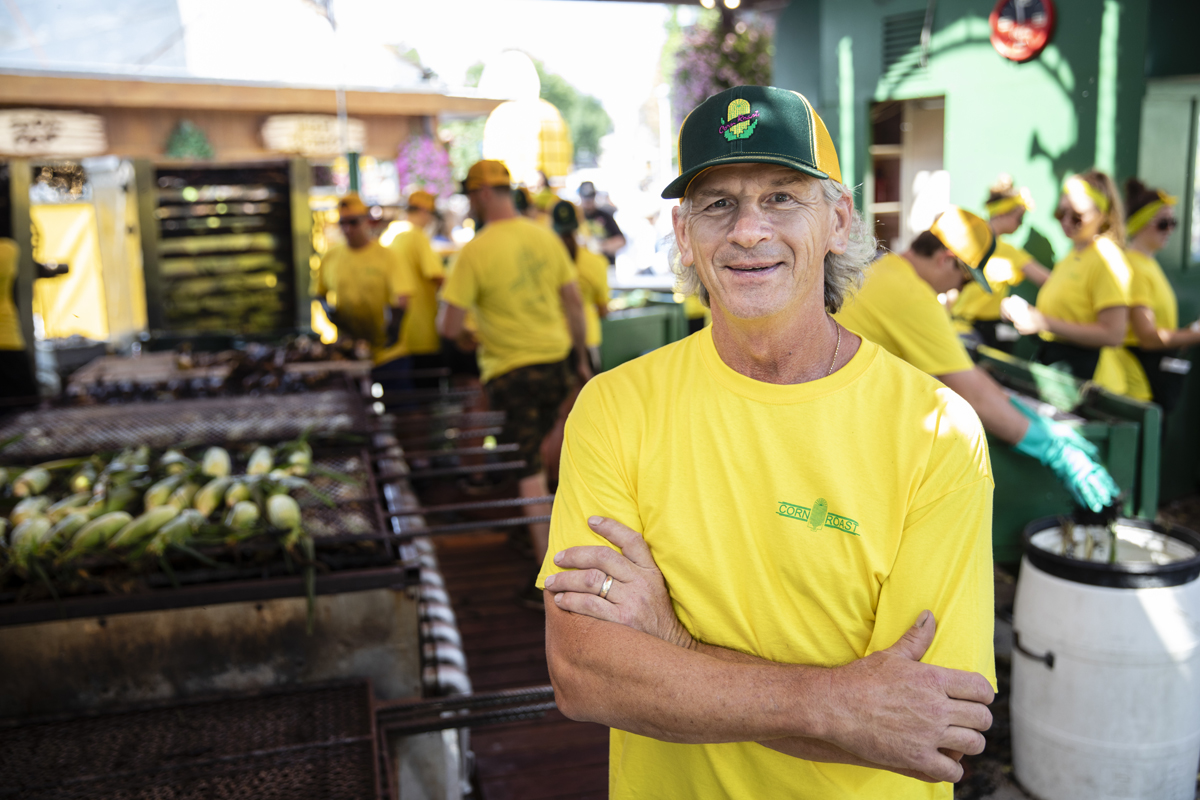
Corn Roast King of the Fair
For many regular fairgoers, a stop at the corn roast stand is a must. But when it first appeared over 30 years ago, it was a slightly harder sell. “The committee just kept saying they couldn’t see it, no one would pay good money for corn on the cob,” says Brad Ribar ‘82 MBA founder, owner and chief roaster at the Minnesota State Fair roasted corn stand.
Now he and his crew roasts and sells a blistering 200,000+ pounds of sweet corn in just 12 days.
Ribar grew up at the Minnesota State Fair, where his grandparents ran the sanitation business for 68 years. “I love the fair. There’s something special about it I’ve never felt at other state fairs or county fairs. When you walk in, you have a sense of excitement, even when no one else is there,” he says.
Ribar got the idea for a corn stand at the Minnesota State Fair while visiting his uncle in Wisconsin. While there, he said, “I asked a hundred questions and, when I left, I knew what I wanted to do.”
He took the idea back to Minnesota and developed it for his business school final project at St. Thomas. His classmates were often people who ran their own businesses and like him, were interested in understanding the finer points. “My professors were also business owners, or people working in corporate America, so I learned a lot I wouldn’t have otherwise learned on my own. That was important to me."
Ribar’s roast corn stand consistently makes the list of top 10 food sellers at the Minnesota State Fair each year. The corn is a “supersweet” hybrid variety that holds more sugar in each kernel. Sweet corn itself is a genetic mutation of field corn that dates back to the 1700s, when it was purportedly first grown in Pennsylvania.
“Really good corn and roasting makes all the difference,” Ribar notes. “Roasting gives the corn a different flavor. It’s richer and deeper. If you roast it for 25 to 30 minutes, the sugar in the corn caramelizes.”
When asked how he landed upon the ideal roasting time, he smiles: “We cooked it for an hour.”
For young entrepreneurs, Ribar has additional advice: “Don’t get discouraged – give anything three years. It takes that long to know if you’ve got a shot or not. I’ve seen many people quit after two years when they were close to making it happen.”